
Telling similar species apart
AnimalDex · 26 September 2026
Tits, pigeons and a few other catalogue pairs: the marks that stop you confirming the wrong card.
The trap of “it looks like that”
Two AnimalDex cards can share a habitat, a colour and even part of a name. The game asks you to confirm the species. Confirming too fast teaches the wrong name, and the next photo repeats the mistake. This guide uses pairs that really are in the catalogue. The useful mark is one you can see on a phone photo, at a fair distance.
Before any pair, note three things: relative size, a pattern on the head or neck, and the real place of the photo. The scientific name on the card settles look-alike common names. “Tit” alone is not a catalogue species. Neither is “pigeon”.
Great tit and blue tit
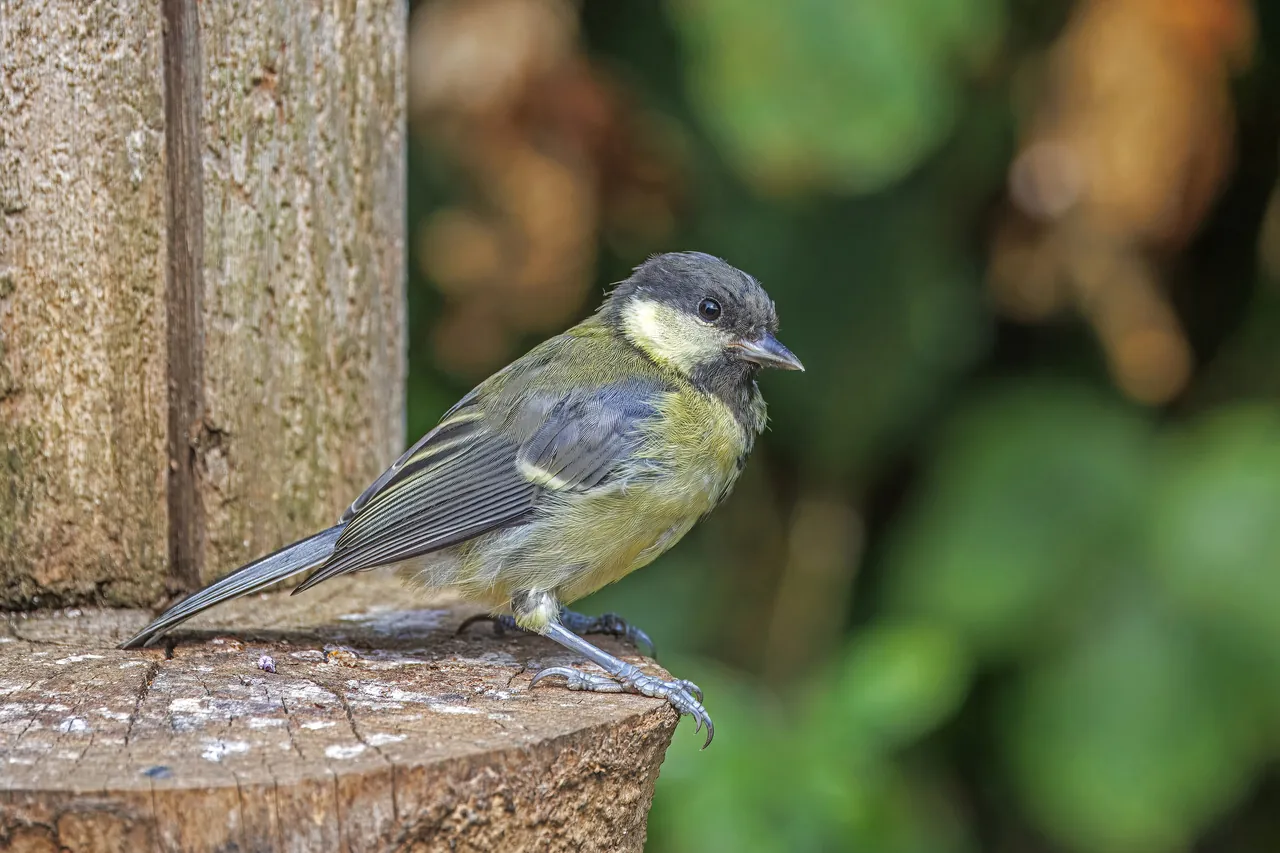
The great tit is larger. Black head, clean white cheeks, yellow belly crossed by a black stripe, the tie. That stripe runs down the middle of the belly and is often wider on the male. The back is greenish, not bright blue.
The blue tit is small and round, with a blue crown, a white forehead, a dark line through the eye and blue wings. The belly is yellow without a heavy central tie. It hangs upside down more often at the tips of twigs. If you only see a blur of yellow and blue, do not choose. Wait until the head is sharp.
Young birds in summer have washed-out colours. The great tit’s tie can be incomplete. Then size and crown are the better marks. Both species come to feeders. One does not exclude the other: a garden often has both, and the collection has to separate them.
Rock dove, wood pigeon and collared dove
The feral pigeon is the town-square pigeon. Medium size, grey plumage, often green sheen on the neck, two black bars on the wing, a pale rump on the classic urban bird. City birds vary: white, red, pied. The structural marks remain a neck without a broad white collar, and the barred wing when the plumage is grey.
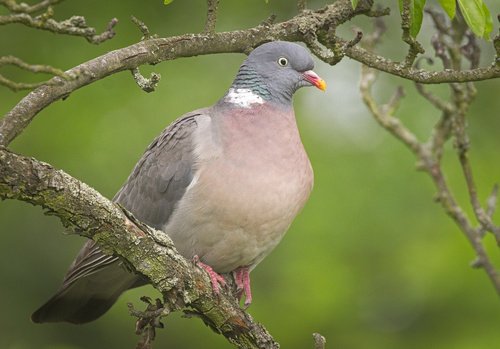
The wood pigeon is larger. In flight the wings show a very visible white transverse band, and the adult neck has a white collar. At rest that collar shows from the side. It uses parks and woodland edges as much as town centres. A “big pigeon” without a collar and without the white wing band is not an adult wood pigeon.
The collared dove is smaller and slimmer, sandy beige, with a thin black half-collar on the nape. Its tail is long, and the underside of the tail shows a lot of white on take-off. It sings a three-note coo from a wire or an aerial. A plain beige bird with a thin black half-collar, in a town or village, is usually this dove.
Farm ducks and pond ducks
The male mallard has a green head, a white neck ring, a chestnut breast, a grey body and a blue wing patch. The female is mottled brown, with the same blue patch edged in white, and an orange bill blotched with black. Both swim fairly flat. You see them on town ponds.
The Muscovy duck, common on farms and sometimes semi-feral, has a bare red or black face around the eye, a heavy body, and often black-and-white plumage. It stands a lot at the edge. A “white farm-pond duck” with red caruncles is not a female mallard. White domestic shapes confuse people: look at the face and the outline before the white plumage.
Gull and black-headed gull
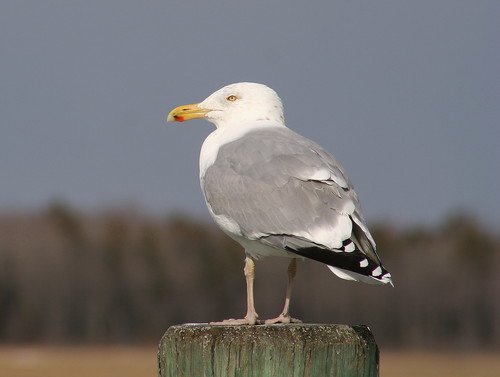
The herring gull is large, with a pale grey back, a white head in winter as in summer on the adult, a yellow bill with a red spot on the lower mandible, and pink legs. Young birds are mottled brown for several years. A young gull is not “another brown species” when the size and the heavy bill fit.
The black-headed gull is smaller. In spring and summer the adult has a chocolate-brown hood, not a black back. In winter the hood goes and a dark spot remains behind the eye. The bill is slim and dark red, the legs red. It uses car parks, ploughland and urban water. If the bird is small and noisy, with a hood or a comma behind the eye, it is not a herring gull.
How to decide on an average photo
First check whether the decisive mark is in the frame: collar, tie, crown, wing patch, caruncle, hood. If it is cut off, take a second photo rather than guess. Behaviour also separates them. A tit upside down, a wood pigeon clattering on take-off, a collared dove on a wire, a Muscovy at the pond edge: those gestures beat a doubtful colour.
In the app, read the scientific name on offer and open the card. The identification section repeats the catalogue sentence and a neighbour from the same habitat. If that neighbour is exactly your doubt, compare the two sentences. Do not confirm just to take the daily challenge XP. A mistake on a common pair repeats dozens of times. An admitted doubt is fixed the next day.
This guide does not cover every catalogue species. It covers the mix-ups that appear as soon as you photograph near home in Europe, including Belgium and northern France. For a zoo species, the enclosure sign and the scientific name outweigh a resemblance to an animal seen on television.
AnimalDex is not animaldex.app. The cards linked at the bottom are those of animaldex.fr. When two French names look alike, the scientific name is the authority, not the memory of another app.